How Long Does a Solar Battery Lifespan Uk?
Solar Battery Lifespan Uk
Solar battery storage has become an important part of residential renewable energy systems across the UK. Many homeowners install batteries alongside solar panels to store excess electricity generated during daylight hours and use it later when their household needs power. However, before investing in a battery storage system, one important question needs answering: how long will the battery actually last?
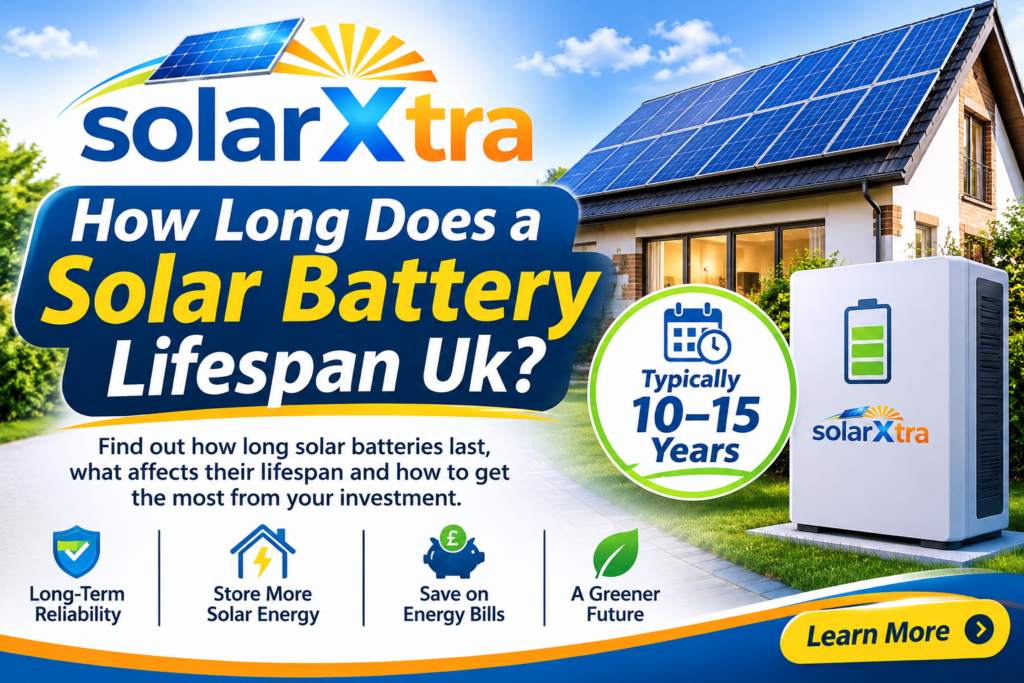
The solar battery lifespan UK homeowners can expect generally ranges from 10 to 15 years, depending on the battery technology, charging habits, installation conditions and maintenance. Some modern battery systems may continue operating beyond this period, although their ability to store electricity gradually decreases over time.
Understanding battery life expectancy is important when calculating long-term savings, planning future maintenance and deciding whether solar energy storage is a suitable investment for your property.
At Solar Xtra, we understand that homeowners need reliable information before choosing renewable energy equipment. This article explains how long different solar batteries last, what causes battery degradation, how to maintain battery performance and when replacing an existing battery may become necessary.
How Long Does a Solar Battery Last in UK?
Most modern residential solar batteries in the UK have an expected working lifespan of approximately 10 to 15 years. Lithium-ion batteries are widely used in domestic solar energy storage because they offer good energy efficiency, relatively high storage capacity and dependable performance.
However, the exact lifespan depends on how frequently the battery charges and discharges, its operating temperature, the quality of its internal components and the manufacturer’s specifications.
For example, a household that uses its battery regularly may experience a different degradation rate from a property that only uses stored electricity occasionally. Similarly, a battery installed in a suitable temperature-controlled environment may maintain its performance better than one exposed to excessive heat or cold.
A solar battery does not necessarily stop working when it reaches the end of its expected lifespan. Instead, its storage capacity gradually decreases. This means an older battery may still supply electricity but cannot store the same amount of energy it could when it was new.
Homeowners should also remember that a solar battery generally has a shorter working life than solar panels. Solar panels can often operate for 25 years or longer, meaning a battery replacement may be required during the lifetime of the original solar installation.
Average Lifespan of Different Solar Battery Types
The technology used inside a battery has a significant impact on its performance, charging efficiency and expected service life. Different battery types have different chemical compositions, maintenance requirements and charging capabilities.
Here are some commonly discussed battery technologies used in energy storage applications.
1. Lithium-Ion Solar Batteries
Lithium-ion batteries are among the most common options for modern residential solar energy storage systems. They provide a useful combination of energy density, charging speed, efficiency and relatively low maintenance requirements.
These batteries store electricity generated by solar panels and release it when household demand increases or solar generation decreases.
A typical lithium-ion solar battery may last approximately 10 to 15 years, although the actual lifespan depends on its chemistry, operating conditions and usage patterns.
Important characteristics include:
- High energy storage capacity relative to physical size.
- Efficient charging and discharging.
- Suitable for regular household energy consumption.
- Integrated battery management systems.
- Relatively low routine maintenance requirements.
2. Lithium Iron Phosphate (LiFePO4) Batteries
Lithium iron phosphate (LiFePO4) batteries are a type of lithium-ion battery used in many modern energy storage applications.
They are recognised for their thermal stability, durability and ability to handle repeated charging and discharging. These characteristics make them an attractive option for homeowners looking for long-term solar battery storage.
Their lifespan depends on the manufacturer’s cycle-life rating and operating conditions. Some models are designed for thousands of charge-discharge cycles.
Benefits include:
- Good thermal stability.
- Strong cycle-life characteristics.
- Suitable for frequent daily charging.
- Reduced dependence on heavy routine maintenance.
- Reliable performance in appropriately designed storage systems.
3. Lead-Acid Solar Batteries
Lead-acid batteries are an older energy storage technology. They have been used in backup power systems, off-grid installations and some renewable energy applications.
Although they can have a lower initial purchase cost, they generally require more maintenance and have a shorter working life than modern lithium-based alternatives.
Depending on the design and operating conditions, lead-acid batteries may last approximately 5 to 7 years.
Their limitations include:
- Lower usable storage capacity in many applications.
- Regular maintenance requirements for certain models.
- Greater sensitivity to deep discharge.
- Larger physical size for comparable usable storage.
- More frequent replacement compared with many lithium-ion systems.
Solar Battery Lifespan Comparison
| Battery type | Typical lifespan |
|---|---|
| Lithium-ion | 10–15 years |
| Lithium iron phosphate (LiFePO4) | Depends on model; often 10–15 years |
| Lead-acid | 5–7 years |
These are general planning estimates rather than guaranteed service lives. Always check the individual manufacturer’s specifications and warranty.
What Factors Affect Solar Battery Lifespan?
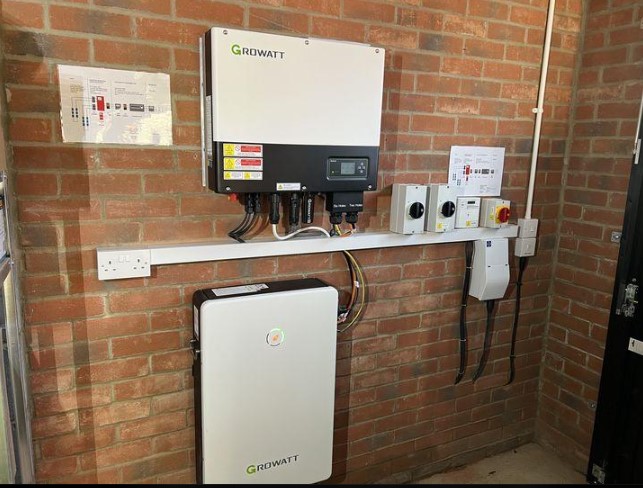
Several factors influence how long a solar battery continues to operate effectively. Even batteries manufactured using similar technology can experience different degradation rates because of their installation environment and daily usage.
Understanding these factors can help homeowners protect their investment and maintain reliable electricity storage.
1. Charging and Discharging Cycles
A charging cycle refers to the process of storing electricity in a battery and subsequently using that stored energy.
Every time a battery charges and discharges, its internal components experience gradual chemical and physical changes. Over thousands of cycles, these changes reduce the battery’s ability to retain its original capacity.
For example, a battery that regularly completes a full charge-discharge cycle may experience different wear from a battery that only provides occasional backup electricity.
Manufacturers often specify a maximum cycle rating to help buyers understand expected battery durability.
However, cycle ratings should not be considered independently. The depth of discharge, temperature and charging conditions also affect battery performance.
2. Operating Temperature
Temperature is another important factor affecting solar battery performance.
Excessive heat can accelerate chemical ageing inside batteries, while very cold conditions may temporarily reduce available capacity and charging performance.
For this reason, installing a battery in an appropriate environment is essential.
Homeowners should consider:
- Installing the battery in a manufacturer-approved location.
- Providing suitable ventilation where required.
- Keeping the system away from direct sunlight.
- Avoiding areas exposed to excessive moisture.
- Following the manufacturer’s temperature recommendations.
A suitable installation environment helps maintain stable operation and reduces avoidable stress on battery components.
3. Depth of Discharge (DoD)
Depth of discharge (DoD) describes how much of a battery’s available capacity has been used.
For example, if a 10kWh battery supplies 5kWh of electricity, approximately 50% of its capacity has been discharged, assuming the full 10kWh is usable.
Regularly discharging a battery to very low levels can increase stress on certain battery technologies.
Modern systems often include battery management controls that maintain safe operating limits. Homeowners should follow the recommended discharge settings rather than manually overriding protective features.
4. Battery Quality and Manufacturing Standards
Not all solar batteries are manufactured to the same specifications.
The quality of battery cells, electronic components, protective systems and manufacturing processes can influence long-term reliability.
Before purchasing a battery, homeowners should examine:
- Battery chemistry and cell quality.
- Manufacturer reputation.
- Cycle-life specifications.
- Usable storage capacity.
- Charging and discharging limits.
- Product and performance warranty.
- Compatibility with the existing solar installation.
Selecting a suitable product from an established manufacturer can help reduce the risk of premature performance problems.
5. Installation Quality
Correct installation plays an important role in the safety and long-term operation of a solar battery.
An incorrectly configured system may experience charging problems, communication errors or unnecessary operating stress.
Professional installation helps ensure that the battery, inverter and other electrical components work together according to the manufacturer’s requirements.
The installer should also assess the available installation space, ventilation, electrical connections and system compatibility.
6. Frequency of Battery Usage
How often a battery is used can influence its overall degradation.
A household that charges and discharges its battery regularly may reach the manufacturer’s cycle limit sooner than a household with occasional usage.
However, fewer cycles do not mean a battery will last indefinitely. Batteries also experience natural ageing over time, even when they are not regularly used.
A balanced operating schedule is therefore important for maintaining long-term performance.
How Does Solar Battery Degradation Work?
Solar battery degradation is the gradual reduction in a battery’s ability to store and deliver electricity.
When a new battery is installed, it has a specified storage capacity. Over time, its internal chemical components change through normal ageing and repeated charging cycles.
As a result, the amount of electricity it can store gradually decreases.
For example, imagine a solar battery with an original usable capacity of 10kWh. After several years of operation, its available capacity might decrease to 8kWh.
The battery may still operate normally, but it will provide less stored electricity than it did when first installed.
Two important measurements help explain this process:
State of Health (SOH): This indicates the battery’s current condition compared with its original capacity or performance when new.
Capacity Retention: This describes the percentage of the original battery capacity that remains available after a period of use.
A battery with 80% capacity retention would have approximately 8kWh of capacity remaining if its original capacity was 10kWh.
The exact degradation rate varies between battery models, so homeowners should check the performance warranty rather than assuming every battery loses capacity at the same rate.
How Many Charging Cycles Does a Solar Battery Last?
A battery’s cycle-life rating indicates how many charge-discharge cycles it can complete under specified testing conditions before reaching a defined performance threshold.
For example, some modern lithium-ion home batteries are designed to handle several thousand cycles.
If a battery completes one full equivalent cycle each day, the approximate time required to reach different cycle ratings would be:
| Cycle rating | Approximate time at one cycle daily |
|---|---|
| 3,000 cycles | 8.2 years |
| 4,000 cycles | 11 years |
| 5,000 cycles | 13.7 years |
| 6,000 cycles | 16.4 years |
| 8,000 cycles | 21.9 years |
These calculations are mathematical illustrations, not guaranteed battery lifespans. Actual service life can be limited by calendar ageing, warranty throughput, temperature and other operating conditions.
It is also important to understand that a partial charge-discharge event does not necessarily count as one complete cycle. Battery manufacturers commonly use equivalent full cycles when measuring performance.
How Can You Extend Your Solar Battery Lifespan?
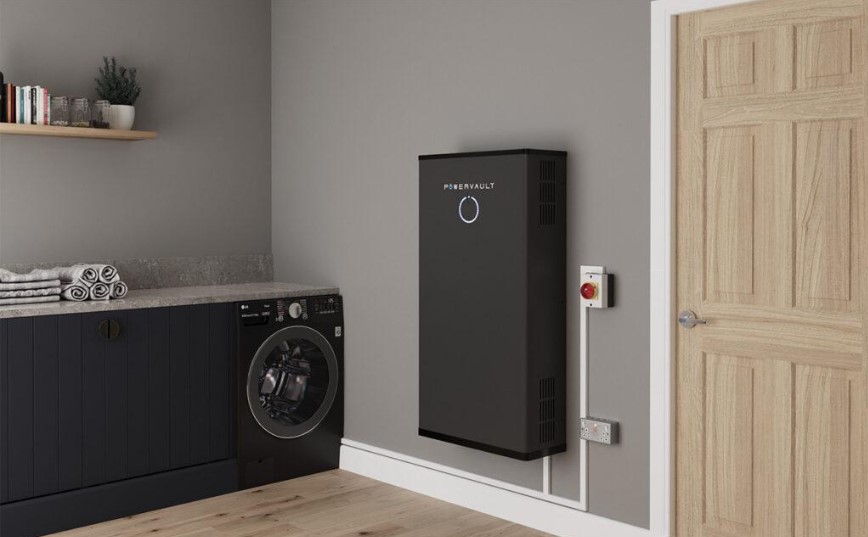
Although battery ageing cannot be completely prevented, suitable operation and regular monitoring can help reduce unnecessary degradation.
Here are practical steps homeowners can follow to maintain their solar battery storage system.
1. Avoid Unnecessary Deep Discharges
Repeatedly discharging a battery beyond its recommended operating range may affect its long-term condition.
Use the battery’s built-in settings to maintain the manufacturer’s recommended minimum charge level.
2. Maintain Suitable Temperature Conditions
Install the battery in a location that meets its temperature and ventilation requirements.
Avoid exposing the equipment to direct sunlight, excessive heat or freezing conditions.
3. Monitor Battery Performance
Many modern battery systems include monitoring applications that display useful information, including:
- Current battery charge level.
- Daily electricity consumption.
- Solar electricity generation.
- Charging and discharging activity.
- Battery operating status.
- System alerts and error notifications.
Checking these details regularly can help homeowners identify unusual changes before they become serious problems.
4. Use Compatible Equipment
A solar battery must work correctly with its inverter and energy management system.
Using incompatible components or incorrect configuration settings can affect system efficiency and reliability.
Always confirm compatibility before adding a battery to an existing solar installation.
5. Follow Manufacturer Recommendations
Different battery manufacturers have different operating requirements.
Follow the instructions provided for charging limits, storage conditions, maintenance and software updates.
Do not open, modify or attempt to repair battery components yourself.
6. Arrange Professional Inspections
Periodic professional inspections can help identify damaged connections, communication problems, warning indicators and other system issues.
The inspection schedule should follow the manufacturer’s recommendations and the installer’s maintenance guidance.
What Are the Signs That a Solar Battery Needs Replacing?
Solar batteries usually experience gradual performance changes rather than suddenly losing all their functionality.
However, certain signs may indicate that an existing battery needs professional assessment or replacement.
Reduced Energy Storage Capacity
If your battery stores noticeably less electricity than it did previously, natural degradation may be responsible.
For example, a battery that previously powered household appliances throughout the evening may now run out of stored energy much earlier.
Shorter Backup Duration
A noticeable reduction in backup time may indicate declining usable capacity or another system problem.
However, changes in household electricity consumption and solar generation can also affect backup duration.
Frequent System Warnings
Repeated battery alerts, communication faults or unusual operating messages should not be ignored.
These warnings may relate to the battery, inverter, wiring or monitoring system.
Unexpected Charging Problems
If the battery regularly fails to charge or discharge as expected, a professional inspection may be necessary.
The problem could involve the battery itself, inverter settings or another electrical component.
Visible Damage or Unusual Heat
Physical damage, swelling, unusual smells or excessive heat require immediate attention.
Stop using the system if it is safe to do so, keep away from the equipment and contact a qualified professional. Do not attempt to open or repair the battery.
Does a Solar Battery Warranty Guarantee Its Lifespan?
A solar battery warranty provides protection under specific manufacturer conditions, but it does not guarantee that the battery will operate at its original capacity for its entire working life.
Many residential lithium-ion battery manufacturers offer warranties of approximately 10 years. However, the exact coverage varies by model.
A battery warranty may include:
Product Warranty: Covers specified manufacturing defects and product-related faults.
Performance Warranty: Defines the minimum capacity or performance the battery should retain during the warranty period.
Cycle or Throughput Limit: Some warranties specify a maximum number of cycles or total amount of energy that can pass through the battery.
For example, a manufacturer may offer a 10-year warranty with a requirement that the battery retains a specified percentage of its original capacity at the end of the warranty period.
Before choosing a system, check:
- Warranty duration.
- Minimum guaranteed capacity retention.
- Maximum energy throughput.
- Cycle limitations.
- Installation requirements.
- Warranty exclusions.
- Product registration requirements.
- Repair or replacement arrangements.
Reading the warranty carefully can help homeowners compare different solar battery storage options more accurately.
How Does Solar Battery Lifespan Compare with Solar Panel Lifespan?
Solar panels and solar batteries perform different functions within a renewable energy system, so their expected working lives are not the same.
Solar panels generate electricity from sunlight, whereas batteries store surplus electricity for later use.
Solar panels commonly have an expected working life of 25 years or more. Residential solar batteries generally have a shorter lifespan, often around 10 to 15 years.
This difference means homeowners may need to replace their battery at least once while continuing to use their original solar panels.
| Component | Typical expected lifespan |
|---|---|
| Solar panels | 25 years or more |
| Lithium-ion solar battery | 10–15 years |
| Lead-acid battery | 5–7 years |
| Solar inverter | Depends on model and operating conditions |
These figures are general estimates. Actual service life depends on the equipment, installation quality, environmental conditions and maintenance.
When planning a solar investment, it is sensible to consider future battery replacement as part of the overall system cost.
When Should You Replace Your Solar Battery?
A solar battery does not necessarily require replacement as soon as its warranty expires.
If the battery continues to operate safely, stores sufficient electricity and meets your household requirements, it may remain useful beyond its warranty period.
However, replacement may be worth considering when:
- Available storage capacity has decreased significantly.
- The battery no longer meets your household electricity needs.
- Repair costs are becoming excessive.
- The system experiences repeated battery-related faults.
- Replacement equipment offers better compatibility or performance.
- The manufacturer no longer provides suitable technical support.
Before replacing the battery, arrange a professional assessment to determine whether the issue comes from battery degradation or another component.
In some situations, an inverter repair, configuration adjustment or system upgrade may resolve the problem without requiring a complete battery replacement.
Is a Solar Battery Worth the Investment in the UK?
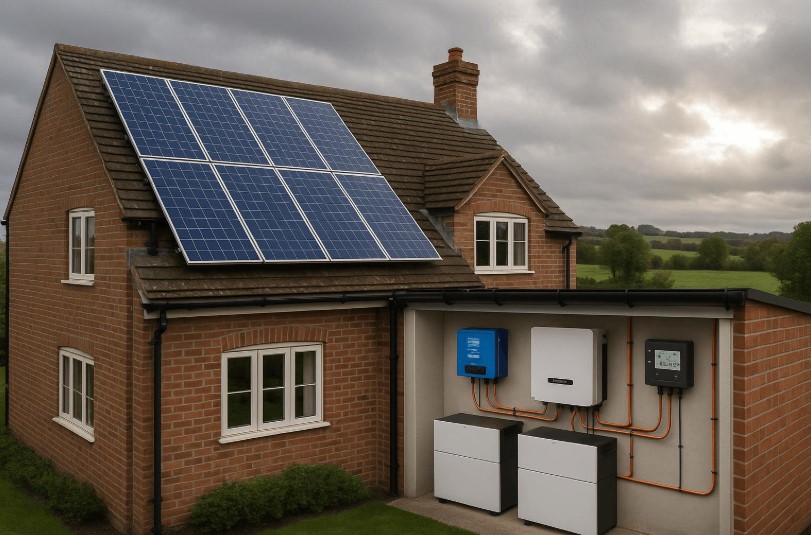
For many UK households, solar battery storage can provide practical benefits by allowing them to use more of the electricity generated by their solar panels.
Without a battery, excess daytime electricity may be exported to the electricity grid. With suitable storage, surplus energy can be saved and used during the evening or at other times when solar generation is limited.
The potential benefits include:
Greater Use of Solar Electricity: Store surplus electricity during daylight hours and use it when household demand increases.
Reduced Grid Electricity Purchases: Using stored solar power may reduce the amount of electricity purchased from an energy supplier.
Energy Management: Some systems allow homeowners to schedule charging and discharging according to electricity tariffs.
Backup Power: Certain battery systems can provide backup electricity during a power cut when configured with suitable backup equipment. Not every battery installation offers this feature.
Renewable Energy Utilisation: Storing excess solar electricity can help households make better use of the renewable energy their panels produce.
However, the financial value depends on the battery purchase and installation cost, electricity tariffs, household consumption, battery efficiency, export payments and replacement requirements.
Homeowners should compare the expected savings over the battery’s useful life with the total cost of ownership before making a decision.
Why Choose Solar Xtra for Solar Battery Installation?
Choosing the right solar battery involves more than comparing storage capacity and purchase prices. Homeowners also need to consider equipment compatibility, electrical requirements, installation conditions and future energy needs.
Solar Xtra provides renewable energy installation solutions designed to help residential and commercial customers make practical use of solar technology.
Whether you are considering adding battery storage to an existing solar panel system or planning a new renewable energy installation, selecting an appropriately designed system is important for long-term performance.
Our approach focuses on understanding your property’s electricity requirements and considering suitable equipment for your energy goals.
When planning a solar battery installation, important considerations include:
- Your household’s daily electricity consumption.
- Existing solar panel generation capacity.
- Required battery storage capacity.
- Inverter compatibility.
- Available installation space.
- Expected charging and discharging patterns.
- Manufacturer warranty and technical specifications.
A properly assessed system can help you use stored solar electricity more effectively while making future maintenance and replacement planning easier.
Contact Solar Xtra to discuss your solar energy requirements and explore suitable battery storage installation options for your property.
Final Thoughts
The typical solar battery lifespan UK homeowners can expect is approximately 10 to 15 years for many modern lithium-ion systems. However, the actual service life depends on battery chemistry, charging cycles, temperature, installation quality and everyday usage.
Although battery capacity gradually decreases over time, a well-maintained system may continue providing useful electricity beyond its initial warranty period.
Before purchasing a battery, compare its cycle-life rating, usable capacity, performance warranty and compatibility with your existing solar equipment.
With appropriate installation, monitoring and operating conditions, solar battery storage can remain a valuable part of a household renewable energy system for many years.
Looking for professional solar battery installation? Contact Solar Xtra to discuss a battery storage solution suited to your property’s energy requirements.
Frequently Asked Questions (FAQs)
1. How long does a solar battery last in the UK?
Most modern lithium-ion solar batteries last approximately 10 to 15 years. Their actual lifespan depends on battery quality, charging cycles, temperature, installation conditions and maintenance.
2. Do solar batteries need replacing after 10 years?
Not necessarily. Ten years is a common manufacturer warranty period, not an automatic replacement date. A battery may continue operating beyond this period if its performance and safety remain acceptable.
3. What type of solar battery lasts the longest?
Lithium-based batteries, particularly lithium iron phosphate (LiFePO4) models, are commonly selected for their durability and cycle-life characteristics. Actual longevity depends on the manufacturer’s specifications and operating conditions.
4. How many cycles can a solar battery last?
Modern lithium-ion solar batteries can be designed for several thousand charging cycles. Some models offer ratings of 5,000 to 8,000 cycles or more, depending on their chemistry and testing conditions.
5. Does using a solar battery every day reduce its lifespan?
Daily charging and discharging contribute to battery wear, but modern batteries are designed for regular use. Following recommended charging limits and operating conditions helps manage degradation.
6. Can a solar battery last 20 years?
Some batteries may continue operating for 20 years, but this should not be assumed for every residential battery. Most homeowners should plan around a shorter typical lifespan and check the manufacturer’s warranty.
7. How do I know when my solar battery is failing?
Common warning signs include reduced storage capacity, shorter backup duration, repeated system alerts, charging problems and unusual physical changes. A qualified professional should assess the equipment.
8. Does cold weather affect solar battery performance in the UK?
Yes. Low temperatures can affect charging efficiency and available battery capacity. Modern battery management systems may control charging to protect the battery, so the manufacturer’s operating temperature limits should always be followed.
9. Can I extend my solar battery lifespan?
You can help maintain battery performance by avoiding unsuitable operating conditions, following recommended discharge limits, maintaining appropriate installation temperatures and monitoring battery health.
10. Is a solar battery warranty the same as its expected lifespan?
No. A warranty defines the manufacturer’s contractual coverage under specified conditions. The actual battery lifespan may be shorter or longer than the warranty period.
11. Do solar batteries lose capacity over time?
Yes. All rechargeable batteries experience gradual degradation. Over time, their ability to store and deliver electricity decreases because of natural ageing and repeated charging cycles.
12. Should I replace my solar battery if its capacity falls to 80%?
Not automatically. A battery with 80% remaining capacity may still meet your energy requirements. Consider its performance, safety, warranty conditions and household electricity consumption before deciding to replace it.
Want to know what solar would save on your own roof?
Book Your Free Survey